Which Door? How Chinese Brands Enter America

A case study in market entry strategy
When a Chinese brand enters America, the first decision is which door.
There are two playbooks. One starts in Chinatown and hopes to cross over. The other walks straight into the mainstream. The choice reveals how a brand sees itself and sets a ceiling on day one.
Act I
The playbook a brand chooses on day one tells you everything about its ambition.
For decades, the default playbook for Asian beverage brands entering the US started in the same places: Flushing. Chinatown. The San Gabriel Valley.
Build a diaspora base, prove demand, then try to cross over. The entire Taiwanese boba wave (Gong Cha, ShareTea, Kung Fu Tea, CoCo) grew this way.
And new Chinese brands are still doing it. In 2024, Molly Tea opened its first US store in Flushing, Queens. Auntea Jenny did the same. Their marketing manager said it plainly: "We chose Chinatown's location to use Chinatown as a gateway."
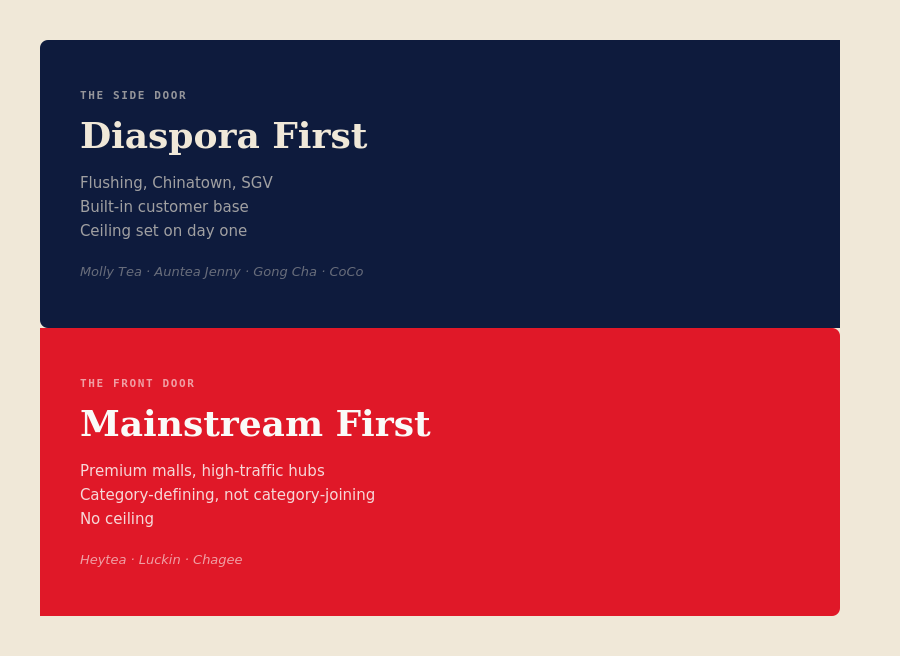
The pattern is quite clean: smaller brands start in diaspora neighborhoods. The biggest, best-capitalized brands head straight for the mainstream. But even among the front-door brands, one made a choice that stands apart.
Heytea and Luckin went to Manhattan.
Chagee went to Century City.
Act II / The Empire

Before it came for America, Chagee conquered China.
霸王茶姬 · NASDAQ: CHA · Founded 2017, Kunming, Yunnan [1]
Zhang Junjie was orphaned at 10. Homeless for seven years. Couldn't read until 18. He taught himself while working 12-hour shifts at a milk tea shop in Kunming. [1]
By 24, he'd founded his own brand. By 32, he'd taken it public on the NASDAQ with a $5.1 billion valuation. [1][2]
Zhang's stated model: Starbucks. A global lifestyle brand built on one core product, operational consistency, and a "third space" experience. He wanted to be bigger than boba.
The Chinese media called it the "Oriental Starbucks." He encouraged the comparison. [1]
Act III / The Wall
Then it all started coming apart.
A timeline of things going wrong
Caffeine hospitalizations
Multiple reports of heart palpitations and ER visits. A large cup contains around 184mg caffeine.[8]
Malaysia lottery rigging
Widely negative sentiment. Legal threats against critics backfire badly.[8]
Ice Borlang ingredient scandal
"Fresh milk" claims challenged when testing reportedly found approximately 19% real milk content, with emulsifiers and thickeners making up the balance.[8]
Nine-dash line controversy
China's territorial claims appear in Vietnam/Malaysia app. Boycott calls. Vietnam entry delayed indefinitely.[8]
"Quasi-drug" influencer claims
14% stock drop in a single day.[8][9]
Barehand drink-mixing video
Employee filmed herself stirring tea barehanded. Trending #1 on Weibo. Store closed. Employee fired.[8]
Stock down 58% from IPO. [2] Same-store sales cratering 20%+. [7] JP Morgan initiates with a Sell rating. [9] The "Oriental Starbucks" narrative is in free fall.
And this is when they decided to enter the United States.

Act IV / The Front Door
Chagee skipped Flushing, skipped Manhattan, and opened in a luxury mall in West LA.
Westfield Century City. Between Gucci and Louis Vuitton. 5,000+ cups served on opening day. [11]
Act V / The Signals
Six choices that declared the competitive set before a single cup was poured
Heytea went to Times Square. High foot traffic, tourist-heavy, volume play. Luckin went to Greenwich Village. Student-adjacent, value-priced, convenience play. Chagee went to a luxury mall in West LA. The address is the positioning.
I. A luxury mall declares the competitive set Century City draws entertainment executives, tourists, affluent West LA. The address positions Chagee against Starbucks Reserve, not against the $4 boba shop down the street.
II. No boba forces a new frame of reference They excluded tapioca pearls entirely. Refusing the most recognizable Asian tea signifier forces customers to judge the product on its own terms.
III. $5.95–$7.75 prices above boba, against Starbucks Positioned against Starbucks lattes, above the $4 boba shops. The price declares the category.
IV. Emily Ratajkowski cuts the ribbon A fashion-adjacent mainstream cultural figure. The signal: we belong in your world, and we brought someone you already recognize.
V. Farmshop Bakery provides the pastry menu A high-end Santa Monica institution. Jasmine tea-infused cruffins. Local culinary credibility, integrated rather than imported.
VI. Laufey bridges East and West in her DNA A Grammy-winning musician. Half Icelandic, half Chinese, fully mainstream. The smartest signal, and the one that hasn't fully broken through yet.

Laufey's first language was Mandarin. [12][13]
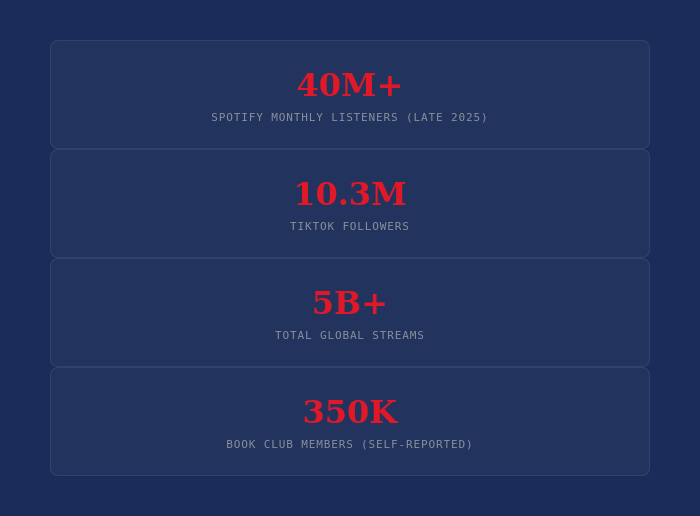
Half Icelandic, half Chinese. Classical training from a family of conservatory musicians. A Grammy winner at 24 for Best Traditional Pop Vocal Album. Over 40 million Spotify listeners as of late 2025. The most-streamed Icelandic artist in history, surpassing Björk. [12]
The paradox that makes it work
Laufey appears niche. Jazz, cello, orchestral arrangements. But her audience is massive and mainstream. She makes vintage feel fresh for people born after 2000.
Chagee appears niche. Chinese tea, cultural heritage, traditional aesthetics. But it operates like Starbucks with 8-second automated service and 7,300 stores.
Both are mainstream operations dressed in niche aesthetics.
Laufey gets discovered for the aesthetic: the vintage look, the orchestral arrangements, the cool factor. She gets kept for the music. It actually works on repeat.
The question for Chagee is whether the same trick works in reverse: can a brand that gets discovered for luxury packaging keep you coming back for the tea?
The US competitive landscape
WHICH DOOR EACH BRAND CHOSE · AND WHAT IT TELLS YOU
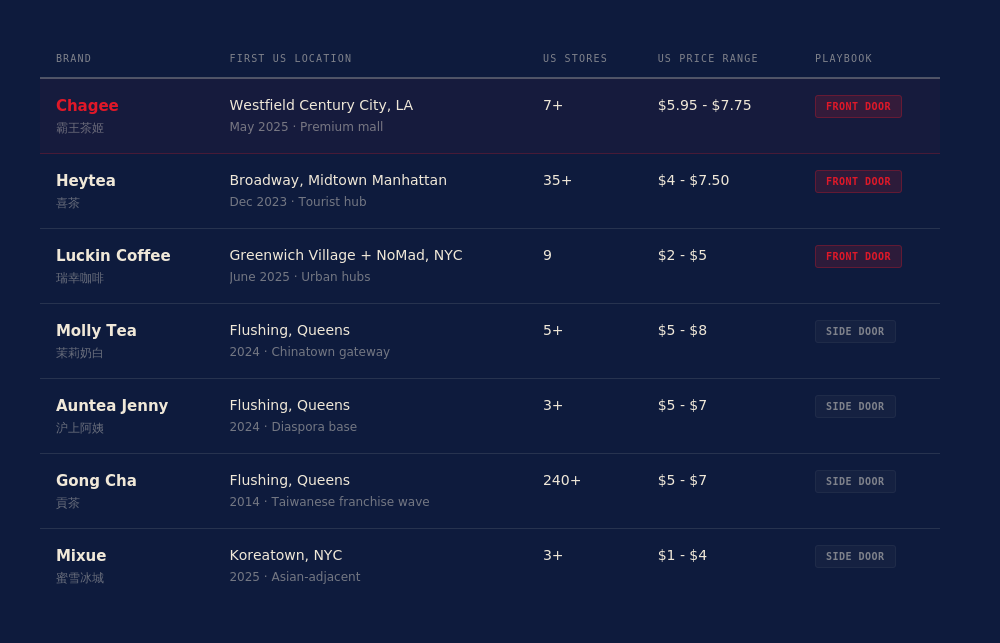
The front-door brands share a common trait: heavy capitalization and a stated ambition to compete at the category level, well above the ethnic niche. Chagee's distinction is the specific door it chose. Where Heytea and Luckin picked high-traffic Manhattan, Chagee picked a lifestyle-coded luxury mall in West LA. [10][11]
The front door gets you in the room. It doesn't guarantee applause.
"Mediocre milk tea at best… prioritizes branding over substance." — Time Out Los Angeles, June 25, 2025 [14]
Time Out LA called it mediocre. [14] The Infatuation compared it unfavorably to Starbucks. [15] The Daily Bruin was more generous. [16] The strategy was brilliant. The product reception was mixed.
The Question
Does the story end here?
Stock down 58%. Same-store sales collapsing. The critics are not impressed. But the playbook, choosing the front door, choosing the right front door, is the most interesting thing a Chinese brand has attempted in the US market in years.
The lesson isn't whether Chagee succeeds. It's what happens after you walk through the door.
The side door still works for building a regional franchise. Gong Cha has 240 US stores to prove it. But for Chinese beverage brands whose ambition is to compete at the category level, to be the Starbucks of tea rather than the ethnic option, category positioning in the US market is set on day one. Chagee got that right.
But the front door gets you into a room. It doesn't furnish it. "Premium brewed Chinese tea" is a category American consumers don't recognize. There is no mental slot for it. Coffee has one. Boba has one. Even matcha has one. Chagee isn't just entering a market. They're trying to build one that doesn't exist yet.
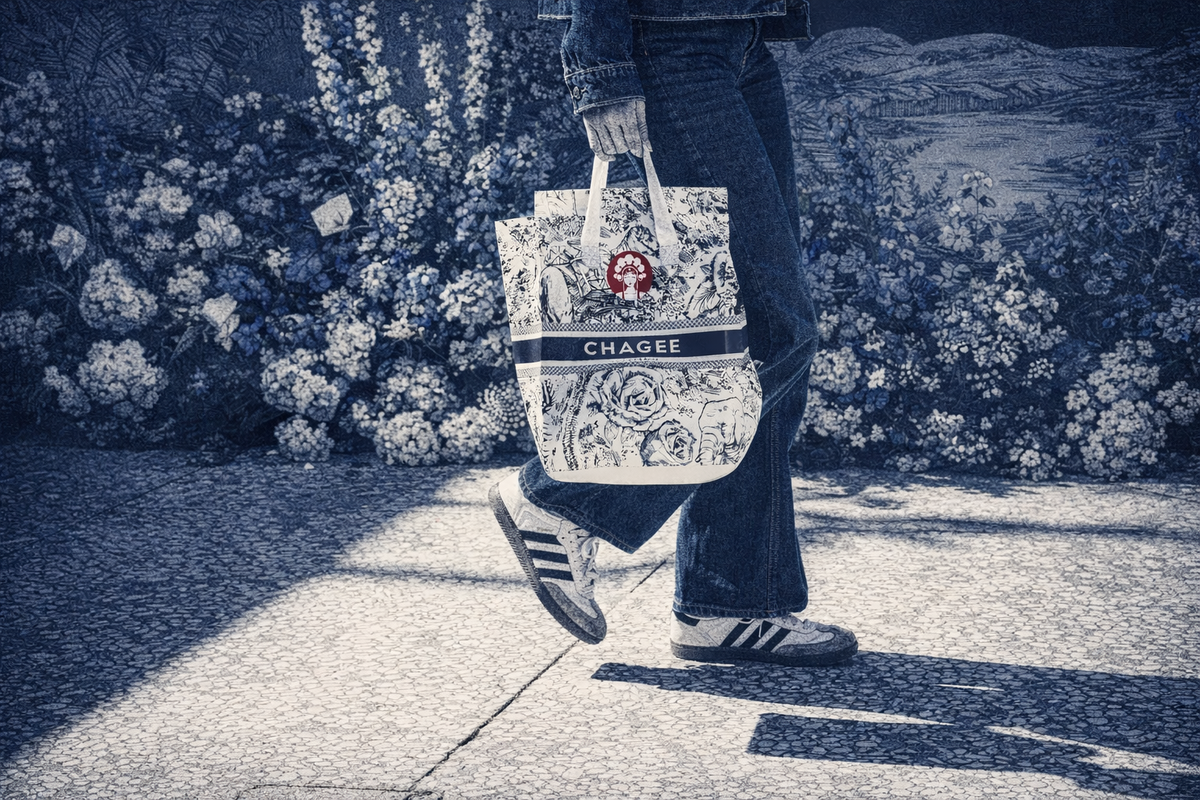
The Dior-esque cup gets people in line on Saturday. The question is what gets them back on Tuesday, and Wednesday, and the week after that. Right now, nobody has answered that question, including Chagee.
The door is open. The room is empty.
Sources
- 36Kr, "CHAGEE: Are the Flagship Products Fading in Appeal?" Dec 3, 2025. Link
- CNBC/Reuters, "Chagee IPO climbs 15% on Nasdaq debut," Apr 17, 2025. Link
- StockAnalysis.com, "Chagee Holdings (CHA) Revenue 2022–2025." Link
- KR-Asia, "Chagee Q3: 7,338 stores globally," Dec 8, 2025. Link
- Chagee 2024 Annual Report (via MarketScreener), net margin data.
- 36Kr company profile, SKU volume/automation claims (company-reported figures).
- 36Kr, same-store GMV analysis: ¥574K→¥378K sequence, Dec 2025.
- Baiguan News, "Chagee PR crisis timeline," Jan 7, 2026. Link
- JPMorgan analyst note, initial Sell rating (via KR-Asia), Q4 2025.
- Eater NY, "Molly Tea opens Flushing flagship," 2024; CNN, "Luckin Coffee opens first US locations," June 2025; Heytea US media coverage, 2023–2024.
- Eater LA, "Chagee Century City: 5K cups Day 1," May 2025.
- Chartmetric/Spotify, Laufey metrics snapshot, late 2025.
- Wikipedia, "Laufey (singer)"; PR Newswire, Heytea Broadway opening, Dec 8, 2023; Gong cha PR Newswire, "Acquires Master Franchise Rights," Mar 2026 (~240 US stores); China Daily, "Tea brands find hot new market in US," Dec 2025 (Heytea 35 US stores per Hongcan).
- Time Out Los Angeles, "Review: Chagee at Century City Serves Mediocre Milk Tea at Best," June 25, 2025. Link
- The Infatuation, "Chagee Tea House" review, Sept 19, 2025. Link
- Daily Bruin, "CHAGEE Modern Tea House's 1st US location delivers both aesthetic and flavor," May 18, 2025. Link
Research and analysis based on SEC filings, Chinese-language business media (36Kr, Jiemian, Guancha, The Paper), and international coverage. All financial figures from Chagee's public disclosures.