A dumpling chain that out-earns steakhouses

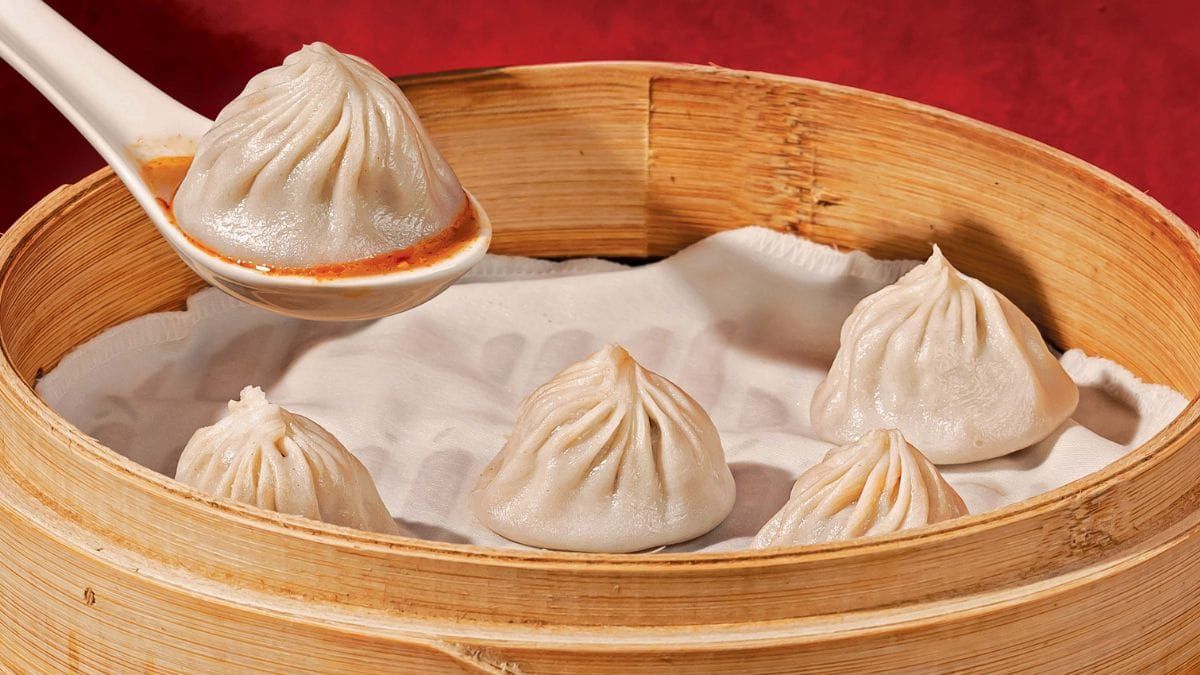
There are restaurant hits. And then there are statistical errors: businesses whose numbers look like typos.
Din Tai Fung generates roughly $27.4 million per U.S. location.¹ That's nearly double the next closest chain, fine-dining steakhouse Mastro's. Roughly two Cheesecake Factories. Almost four Chick-fil-As. Just under seven McDonald's.²
These are not comparable businesses. Mastro's is a white-tablecloth steakhouse. Chick-fil-A is a drive-through. They differ in footprint, daypart count, average check, and seat turnover.
Average Unit Volume, 2024
Location type, footprint, and customer base differ across all five.
The comparison is not a ranking; it marks how far outside normal restaurant economics Din Tai Fung operates, selling a product most Americans associate with a $6 takeout container.
What made Americans willing to pay $18 for a basket of soup dumplings?
What Americans assume about premium Chinese food
Every category carries a default story. For the American diner encountering Din Tai Fung without prior context, "Chinese food" carries one of the most stubborn.
It's supposed to be cheap. It's supposed to be fast. Portions should be huge. And beneath the surface: an unspoken suspicion about hygiene and authenticity.
This is the author's interpretive frame, not a surveyed finding, but it is grounded in observable market conditions.
Premium Chinese restaurants in the U.S. have historically struggled with price resistance that comparably priced Japanese, French, and Italian restaurants do not face.
The gap is visible in average check data across fine dining categories and in the relative scarcity of high-end Chinese concepts outside coastal metros.
The default is real, but uneven.
Din Tai Fung's U.S. footprint is geographically concentrated: the majority of its locations are in California, with additional restaurants in Washington, Oregon, Nevada, New York, and Arizona as of early 2026.
In several of those markets, upscale Chinese dining has existed for decades. A significant portion of DTF's early American customer base arrived already converted.
The New York Times named the original Taipei location one of the world's ten best restaurants in 1993, seven years before the first U.S. location opened. Those customers came as pilgrims, already convinced.
DTF's harder problem was everyone else: the mainstream premium diner who had never heard the name, who was being asked to pay steakhouse prices for dumplings on the strength of a long queue and a glass wall.
That customer brought the category's default price resistance. For that specific customer, the glass wall and the precision specs had a job the brand's pre-existing reputation could not reach: convert a skeptic with no particular reason to believe the premium was real.
Din Tai Fung's restaurants are polished, its prices are premium, and its processes are meticulous. Without earning trust from that skeptical segment, none of that reads as quality. It reads as overpriced.
The company did not argue with the default. It did not run ads explaining why the dumplings were worth it. It built a restaurant where the customer could verify the product without being asked to take anyone's word for it.
Mystery → Observable
The glass wall: how observable production converts doubt
Most restaurants ask you to trust what happens behind a closed door. Din Tai Fung replaces the door with glass.
The glass kitchen is a proof surface: a specific touchpoint where a skeptical customer can stop and verify a claim in ten seconds or less, rather than accepting it on faith.
An NUS Business School case study, based on eighteen months of research access, documented how the open kitchen format converts doubt into direct observation rather than requiring the customer to take the brand's word for anything.⁴
When you can see the dumplings being made, hygiene becomes something you observe directly. Craft becomes a motion you can count.
A restaurant willing to be watched is sending a signal that extends beyond reassurance: it is volunteering for scrutiny.
In a market where the skeptical customer's default posture toward an unfamiliar premium category is distrust, that transparency is a competitive advantage most rivals cannot replicate without redesigning their operations from the kitchen out.
Numbers give customers a reason to repeat
Most premium brands describe quality with words: artisanal, authentic, handmade.
Din Tai Fung describes it with numbers. A dumpling becomes a measurable object: 21 grams, 18 folds.³
This matters because numbers give customers a socially acceptable reason to pay more. A diner who cannot articulate why the food is better can repeat a spec: "Every dumpling, exactly the same weight."
The number does the persuasion work that subjective enthusiasm cannot. It converts a taste preference into an observable standard.
The logic of the flywheel (and what it does not prove)
Seen separately, each element is reasonable: a glass kitchen, a few specs, a well-managed queue, a disciplined twelve-week training pipeline.⁵
Seen together, they appear to form a reinforcing system. The following is the author's reconstruction of the logic, not a documented causal chain:
Transparency reduces the customer's anxiety about the unknown. Watching the kitchen confirms the specs in real time: 18 folds, 21 grams, right there.
The claim and the observable reality become the same thing. That alignment gives the customer a story to repeat to friends. The story justifies the price.
The margin funds the training and ingredients that competitors on thinner returns cannot sustain, and that investment maintains quality on the second visit as reliably as the first.
The $27.4M annual revenue per location is real. The question is how much of it this mechanism explains. The honest answer: we do not know.
What can be said is that Din Tai Fung built a restaurant where trust is manufactured on-site, in real time, and that this design is unusual enough to be worth examining as a deliberate strategic choice rather than an accident of good dumplings.
What this mechanism does not explain
The proof-surface thesis is not a complete account of DTF's U.S. economics. Several factors contribute to the $27.4M AUV independently of the trust mechanism:
Scarcity. Din Tai Fung operates fewer than twenty U.S. locations, geographically concentrated in a handful of high-income metro areas as of early 2026.
Concentrated demand in high-traffic locations inflates per-unit revenue in ways that would dilute with broader expansion. Whether the AUV holds as the footprint grows is an open question.
Pre-existing reputation. The NYT 1993 designation and decades of word-of-mouth from Asian and Asian American food communities mean a substantial share of DTF's customer base arrives pre-convinced. The glass wall did not convert those customers. They were already sold.
Location strategy. DTF sites in the U.S. are overwhelmingly in premium retail corridors with high foot traffic. The real estate strategy contributes to revenue density independently of any in-store experience design.
Menu engineering. High average check, beverage attachment, and efficient seat turnover all contribute to AUV. These are operational variables, not trust variables.
The proof-surface mechanism is a plausible and well-documented component of DTF's brand architecture. It is not a sufficient explanation of its revenue, and this piece does not claim otherwise.
Proof surfaces work when the doubt is about quality
If you're an Asian brand entering the U.S., you've probably been told to be authentic, to tell your story. That instruction misses what moves the skeptical American customer past price resistance in an unfamiliar premium category.
The transferable principle is narrower than "be transparent." It applies most directly in categories where three conditions hold: the customer's doubt is about product quality rather than brand awareness; the production process can be made at least partially observable; and the proof can be verified quickly, without expertise.
Restaurants, food production, and manufacturing meet these conditions naturally. A skincare brand could show formulation. A consumer electronics company could expose testing protocols.
The mechanism translates wherever the customer's core objection is "I don't believe this is worth what you're charging" and where observable evidence can answer that objection faster than advertising.
It translates less well where the doubt is about status, identity, or cultural fit rather than product quality. A fashion brand facing the question "Is this cool?" cannot answer it with a glass wall.
A technology platform facing the question "Will my colleagues judge me for using this?" cannot answer it with specs. The proof-surface mechanism is a tool for converting quality skepticism.
Start with the uncomfortable question: what does America doubt about you? If the answer is about quality, build proof surfaces. If the answer is about something else, this mechanism is not your answer.
Sources
¹ $27.4M AUV - Technomic Top 500 Chain Restaurant Report, 2025 (2024 data); reported by Restaurant Business, Jun 2025
² Competitor AUV comparisons - Restaurant Business, Jun 2025, framing Technomic data: "nearly double that of the next closest chain, the fine-dining steakhouse Mastro's"; "combining two Cheesecake Factories"; "almost four Chick-fil-As"; "just under seven McDonald's." Exact comparator AUVs are from the paywalled Technomic report and are not independently confirmed here. These concepts differ in format, footprint, daypart, and customer base; the comparison illustrates revenue-density range, not operational equivalence.
³ 18 folds / 21 grams - MICHELIN Guide interview with Albert Yang, 2024; Globe and Mail interview with James Fu, May 2025; Los Angeles Times, Dec 2023. Multiple primary sources confirm both specs.
⁴ Glass kitchen as trust mechanism - NUS Business School case study (Prof. Brian Hwarng), 18-month research access; published 2016 via Ivey Publishing; won 2015 Decision Sciences Institute Best Teaching Case Studies Award.
⁵ 12-week training pipeline - Los Angeles Times, Dec 2023; Globe and Mail, May 2025. Albert Yang quoted directly: "Our current training program is 12 weeks."
Full evidence package and source verification available on request.